As promised, the next instalment for beginners is here. Tension is one of the most important things in both knitting and crochet. However, it is a little complicated, and can easily be misunderstood. The first part of tension lies in how a crafter holds their yarn. The tighter you hold it, the tighter your stitches will be, and the less yarn you'll use. If your stitches are too tight, however, they will be extremely difficult or even impossible to work.
The second part of tension involves how many inches per so many stitches and rows you get when you work with yarn. This is called gauge. You can see what gauge you should be getting when you look on the ball band (the band circling or attached to a skein of yarn.) If you look in the middle, between the washing instructions at the top and the weight at the bottom, you will see a pair of crossed needles with a size under them, and next to that a square that reads "10 x 10 cm, 30 rows, 22 stitches." This means that when you knit 22 stitches over 30 rows with 4 mm needles, you should get a square that measures 10 cm - which is also 4 inches.
Using this information helps you figure out if the garment you're making will the the right size. While many things don't require gauge swatches, such as scarves, blankets, shawls and stoles, other things, especially sweaters, really need them. The pattern will include the required gauge/tension. It will be in the form of 10 cm/4 inches = x stitches over y rows, usually similar to the gauge on the ball band of the yarn suggested in the pattern.
To find whether your personal tension matches the tension required to make your garment the right size, you need to take the yarn you're going to use and the needle size suggested on the ball band, and work a gauge swatch, also called a tension square. To the right, you will see some of the ones I have done; the one in yellow was knit in the round because it was for a hat that was to be worked in the round. Keep in mind that when you knit your square, you want to knit it either flat if your project is flat, or in the round if your project is going to be in the round. A person's tension often varies between these two styles of knitting.
The swatch is easy enough to work. You cast on the number of stitches the tension of the pattern suggests, and knit the required number of rows. You then cast off and measure the swatch. It's strongly suggested in most circles that you also wash it, to give a good indication of what the material will do once it's been put through what the finished garment will go through. If it measures 10 x 10 cm (4 inches square) then you are set. But what if it doesn't? If it is too big, go down a needle size. If it is too small, go up a needle size. You may have to try a few times to get the right size needle if your tension is not typical to what is on the ball band, or if you are using a different yarn to that suggested in the pattern. For example, a DK weight yarn called for in the pattern might be slightly thicker or thinner than one you decide to use instead, and so the tension will be slightly different.
A note on yarn substitution: if you are going to use a different yarn to make a project than one suggested, it is a good idea to use one of the same weight. Using a different weight yarn will change the math of the pattern, as you will need to cast on more or less stitches for a thinner or thicker weight of yarn. While you would need to do a tension swatch to know how many stitches you'd need to cast on and work, this is a little more advanced and shouldn't be tried until you are very comfortable with how patterns fit together.
I will be the first to admit that I don't always swatch. I know my tension usually matches that of the ball band, and I can alter things if I find my pattern going awry while I am knitting. This comes with practice and confidence. I still get caught out, however, and have had some catastrophes in my time. I tend to swatch for sweaters and hats for the most part, and always when I made things for other people. Tension swatches are a good idea for making sure things fit and look their best on the intended wearer, and should be used accordingly.
Showing posts with label beginners. Show all posts
Wednesday, 5 February 2014
Thursday, 30 January 2014
Tips and tricks for new knitters: Needles and Hooks
One of the first questions facing the new crafter is "What kind of needle/hook should I get?"
Hooks are also made of several different things. I bought a set when I first started crocheting. The smallest hooks were made of metal, presumably steel. The bigger hooks were made of plastic, and I bought some that were made of wood. Some have handles that are made of a different substance to the hook itself. One hook I have has a wooden handle and a metal hook. Some hooks offer easy grips that have gel like handles and can have either a metal or plastic hook. If you suffer from arthritis or pain in your arms, something with an easy grip would be better for you. KnitPro makes a hook called Waves that offers easy grip; Clover offers two that I know of - Amour and Soft Touch. I have not used any of these hooks, but have been told the Amour are a nicer version of the Waves. I do not know the difference between the Soft Touch and the Amour.
Knitting also has different kinds of needles. In addition to the straight needles that everyone may be familiar with, there are double pointed needles ((DPNs) and circular needles. These last two kinds were developed for knitting in the round, although I use circulars as well for knitting flat as well. Circulars come in two different kinds too - fixed, where you have a cable between the needles that is a certain length, and where the needles are a certain width, and interchangeable, where you have a set. The set comes with needle tips of varying widths (usually ranging from 3.5mm to 8mm) and cables that make up a circular needle length of 16" to 32" or longer. Circular needles can be used to knit things which are too long for straight needles - the body of a sweater, or a shawl, which often has 300+ stitches in some part of it. The cable in between the needles holds the work, and I find it very useful in working with heavy items such as large garments. It helps take weight off the wrists and prevent RSI or other kinds of pain.
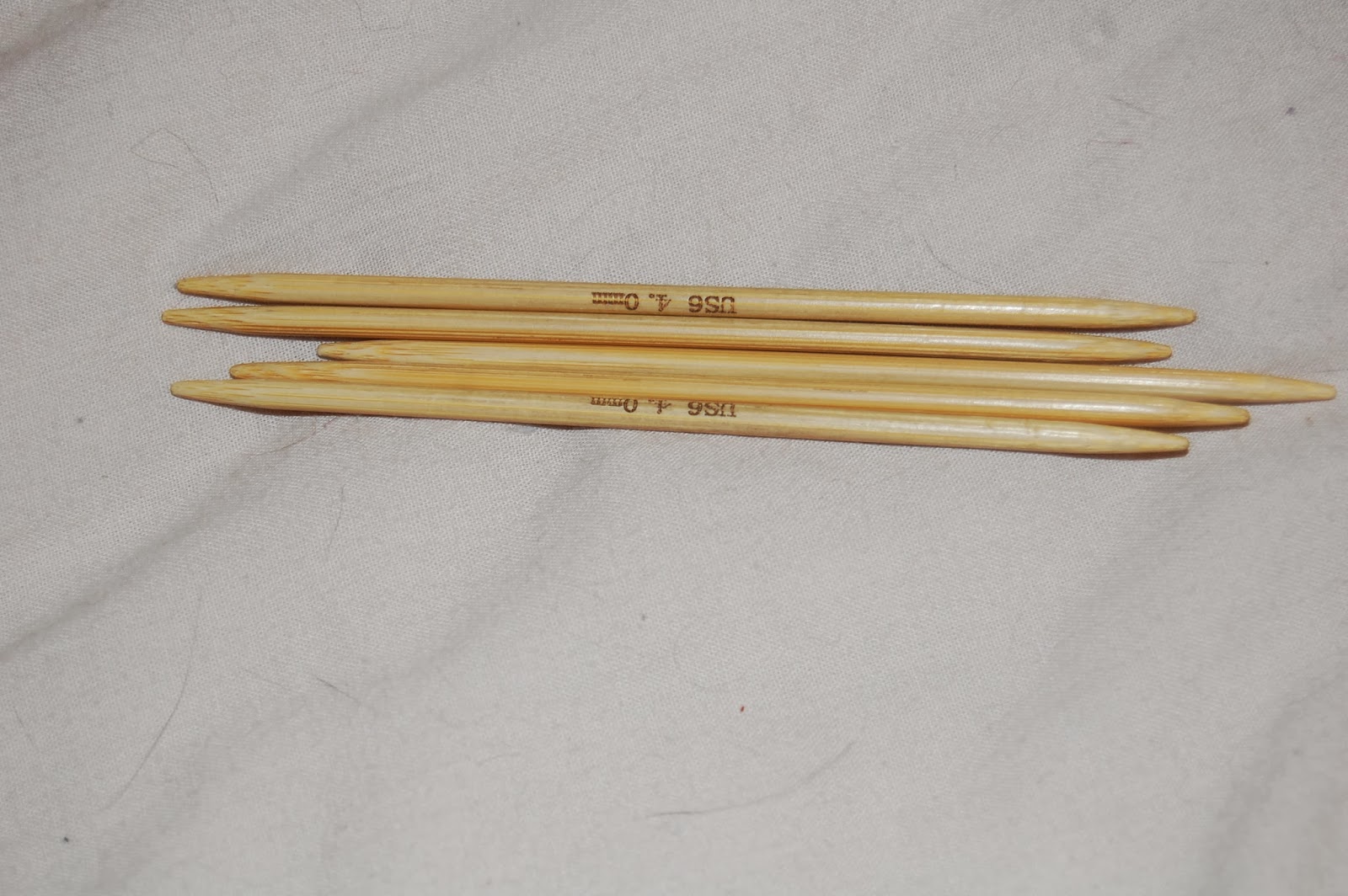
One thing to remember with double pointed needles is that you only work with two at a time; most of the needles simply hold stitches, much as a straight needle does. Depending on the number of stitches in your row, you can either use all five, or just four. A minimum of three needles is needed to hold the stitches, and you work with the one not holding any. Rubber tips can be gotten to put on the end you're not working with so the stitches don't slide off.
My answer? It's very much down to the individual and how you like the feel of different materials in your hands. I'll start with hooks, because there seems to be a little less choice involved with them than with needles.
Crochet hooks come in a range of sizes. The smallest run to about .6mm, and the largest can be upwards of 10mm. (American sizes use letters, but I find the millimetre to be more exact.) The sizes, like those of knitting needles, are dependant on the thickness of the yarn. Cobweb and laceweight yarn use the smaller needles, while working up through the different sizes you use bigger and bigger hooks or needles. More on that below.
| My set of crochet hooks. The one with a hook at each end is two different sizes. |
Disclaimer: It is my firm opinion that hooks and needles are a very personal thing. What one person really likes using, another person might not like. I will not recommend any kind of needle or hook for this reason, but will only say what I like using and encourage you to try different types yourself. Many local yarn stores will let you try out a type of hook or needle before buying. It can't hurt to ask.
Needle are made of much the same things. Wood, metal, and plastic seem to be the default materials, but with knitting I find that depending on the yarn you use, you will want to use different types of needles. Because in knitting you have many stitches on the needles, what yarn you use will be affected more than in crochet, where you have at most two or three loops on your hook.
Slipperiest of all are the metal needles. These are either nickel or stainless steel as far as I know, and different manufacturers will advertise what their needles are made of. One yarn I usually use metal needles for is silk yarn. It tends to grip the needle, and when I tried to knit with silk on a wooden needle, I could hardly slide it up and down. Switching to metal made it much easier to work the rows.
Next comes plastic needles. These are hard and durable, usually the cheapest of the needles, and I started on these. I found they worked pretty well for most types of yarn, but the ends are blunter than wooden or metal needles as a general rule, so if you're trying to work fine or splitty yarn, they might not be ideal.
Finally, the wooden needles. These are comprised of either hardwoods like the KnitPro Symphonies, or bamboo. Bamboo needles are often soft on the hands, and warm up as you work, making them ideal for people with aches and pains in the hands or arms. Hardwood needles offer a superior gripping surface for the yarn, and are great for yarns that like to slide around a lot. If you're having trouble keeping yarn on the metal or plastic needles, go for the hardwoods.
| Double pointed needles. |
| One set of circular needle tips with different sized cables. |
One thing to remember with double pointed needles is that you only work with two at a time; most of the needles simply hold stitches, much as a straight needle does. Depending on the number of stitches in your row, you can either use all five, or just four. A minimum of three needles is needed to hold the stitches, and you work with the one not holding any. Rubber tips can be gotten to put on the end you're not working with so the stitches don't slide off.
I was going to cover tension swatches in this article as well, but I find I've rambled on somewhat about needles, so I'll leave that for next time. I'll leave you with this chart on what size needles work best with the different weights of yarn.
Laceweight (2-ply): 1.5-2.25 mm (US 000-1)
Fingering (also called sock weight or 4-ply): 2.25-3.25 mm (US 1-3)
Sport (also called baby or 5-ply): 3.25-3.75 mm (US 3-5)
DK (double knit): 3.75 - 4.5 mm (US 5-7)
Worsted and Aran: 4.5-5.5 mm (US 7-9)
Chunky: 5.5-8 mm (US 9-11)
Bulky (also called superchunky): 8 mm + (US 11 +)
Tuesday, 28 January 2014
Monday special: Tips and tricks for beginning knitters
I've noticed that several of my friends have decided to take up knitting or crochet recently, and many have been asking for advice. As with most people who love their craft, I am always keen to pass on information and help to new crafters. Sharing the joy of working with yarn is something that any knitter, crocheter, or spinner can relate to.
With that in mind, I've decided to do a semi-regular series on getting started in the world of yarn craft. These will likely be posted once or twice a week in addition to my regular weekly post.
I'm going to start with yarn. Yarn is the one material crocheters and knitters have to know best, and while getting to know how different yarn behaves is part of the learning process, there are some things I have learned through trial and error that might benefit people just starting out.
There are several different materials that yarn is made of. Probably the most well known and common to work with is wool. Wool comes from the fleece of a sheep, and there are many different breeds of sheep, so there are many different kinds of wool. The wool from the Bluefaced Leicester (BFL) and Merino breeds of sheep are common in use today. They are usually soft enough to wear close to the skin of all but the most sensitive person. However, there are many, many more breeds, and each has it's own characteristics. Wool often offers sturdy material once knitted up, and many types will felt. Felting is when the fibres of the wool stick closer together and make a very dense fabric, shrinking whatever has been made with it.
Superwash wool is wool that has been taken and chemically treated so that it does not easily felt. This can be more safely machine washed. This kind of wool is popular for socks and gifts, especially baby items that a busy parent can just throw in the machine instead of gentle hand washing.
Another type of yarn is that of the camel. Other camelids are also used, alpaca especially, and these are considered a more luxury yarn. The fabric they make often drapes nicely, making a different kind of fabric to that of pure wool. They are also very warm. One thing I have noticed about alpaca specifically is that is tends to "grow" as you work with it, and even after you are done with the project. I made a cardigan out of an alpaca blend yarn (with some silk and some wool) and it has grown to be too large for me, especially in the arms. One trick I have learned with working with this fibre is to use a smaller needle size than you would otherwise, because it will get bigger. Washing it does shrink it somewhat, but with wear it will grow again.
Other animal fibres used in yarn include angora, which provides a halo effect when knitted up, and silk, which gives a bright sheen to the yarn. Silk takes dye especially well, so any yarn with silk in it tends to be brilliantly colourful.
Plant fibres used in yarn are extremely varied. Personally, I have used yarn made of sugar cane, bamboo, cotton, and soya, and I know there are others out there. I am sadly ignorant of how these fibres are spun into yarn, but together they make up a wonderful selection of yarns that can be worn in warmer weather. Cotton comes in two forms; mercerised, where the strands have been treated so they do not separate easily, and regular, where the strands are a little more separate.
In crochet, I find mercerised cotton easier to work with. The strands (plies) do not separate easily, and this makes it easier to take the hook through all plies without splitting them. In knitting, it is a little easier to take the needle through all the plies, although you have to pay attention. Splitting a ply in your yarn makes the finished work look untidy at best.
The way plant fibres are processed usually leads to a splitty yarn, and care must be taken when working with these yarns, but they produce delightful results. Cotton is my favourite material to crochet with.
There are myriad books written on the different properties of different types of yarn; I can not even begin to cover them all here. One thing I really recommend is doing your homework when starting a project with a new-to-you yarn. Ravelry comes in very handy here. For those of you not familiar with the website, it is a kind of network for yarncrafters. Databases with patterns and yarn are built into the site, along with forums and groups that you can join depending on your interests. There are thousands, if not millions, of different patterns, both free and for sale; there are also entries for nearly every yarn you can buy. These entries have information such as washing instructions, what fibre(s) are in the yarn, and many other useful things. They also have comments users have made based on their experiences with it. Reading these comments requires only a free membership, and can give you insights into how the yarn will behave while being worked and what the finished object will do. Will it felt? Grow? Look good with those cables you want to put in? It's all there.
Next time, I'll talk about needles and tension. If you have any requests, please feel free to leave me a comment and I'll do what I can!
With that in mind, I've decided to do a semi-regular series on getting started in the world of yarn craft. These will likely be posted once or twice a week in addition to my regular weekly post.
I'm going to start with yarn. Yarn is the one material crocheters and knitters have to know best, and while getting to know how different yarn behaves is part of the learning process, there are some things I have learned through trial and error that might benefit people just starting out.
There are several different materials that yarn is made of. Probably the most well known and common to work with is wool. Wool comes from the fleece of a sheep, and there are many different breeds of sheep, so there are many different kinds of wool. The wool from the Bluefaced Leicester (BFL) and Merino breeds of sheep are common in use today. They are usually soft enough to wear close to the skin of all but the most sensitive person. However, there are many, many more breeds, and each has it's own characteristics. Wool often offers sturdy material once knitted up, and many types will felt. Felting is when the fibres of the wool stick closer together and make a very dense fabric, shrinking whatever has been made with it.
Superwash wool is wool that has been taken and chemically treated so that it does not easily felt. This can be more safely machine washed. This kind of wool is popular for socks and gifts, especially baby items that a busy parent can just throw in the machine instead of gentle hand washing.
Another type of yarn is that of the camel. Other camelids are also used, alpaca especially, and these are considered a more luxury yarn. The fabric they make often drapes nicely, making a different kind of fabric to that of pure wool. They are also very warm. One thing I have noticed about alpaca specifically is that is tends to "grow" as you work with it, and even after you are done with the project. I made a cardigan out of an alpaca blend yarn (with some silk and some wool) and it has grown to be too large for me, especially in the arms. One trick I have learned with working with this fibre is to use a smaller needle size than you would otherwise, because it will get bigger. Washing it does shrink it somewhat, but with wear it will grow again.
Other animal fibres used in yarn include angora, which provides a halo effect when knitted up, and silk, which gives a bright sheen to the yarn. Silk takes dye especially well, so any yarn with silk in it tends to be brilliantly colourful.
Plant fibres used in yarn are extremely varied. Personally, I have used yarn made of sugar cane, bamboo, cotton, and soya, and I know there are others out there. I am sadly ignorant of how these fibres are spun into yarn, but together they make up a wonderful selection of yarns that can be worn in warmer weather. Cotton comes in two forms; mercerised, where the strands have been treated so they do not separate easily, and regular, where the strands are a little more separate.
In crochet, I find mercerised cotton easier to work with. The strands (plies) do not separate easily, and this makes it easier to take the hook through all plies without splitting them. In knitting, it is a little easier to take the needle through all the plies, although you have to pay attention. Splitting a ply in your yarn makes the finished work look untidy at best.
The way plant fibres are processed usually leads to a splitty yarn, and care must be taken when working with these yarns, but they produce delightful results. Cotton is my favourite material to crochet with.
There are myriad books written on the different properties of different types of yarn; I can not even begin to cover them all here. One thing I really recommend is doing your homework when starting a project with a new-to-you yarn. Ravelry comes in very handy here. For those of you not familiar with the website, it is a kind of network for yarncrafters. Databases with patterns and yarn are built into the site, along with forums and groups that you can join depending on your interests. There are thousands, if not millions, of different patterns, both free and for sale; there are also entries for nearly every yarn you can buy. These entries have information such as washing instructions, what fibre(s) are in the yarn, and many other useful things. They also have comments users have made based on their experiences with it. Reading these comments requires only a free membership, and can give you insights into how the yarn will behave while being worked and what the finished object will do. Will it felt? Grow? Look good with those cables you want to put in? It's all there.
Next time, I'll talk about needles and tension. If you have any requests, please feel free to leave me a comment and I'll do what I can!
Subscribe to:
Posts (Atom)